
Confidence is in beta. It starts on its own when a simulation finishes and takes a while to come back. It appears for members of your organization and is not shown on shared report links.
The bar every question is held to
A twin’s answer is useful when it is close to what the real audience would say. We use the decision-grade bar common in market research: the twins’ answer shares and the real audience’s shares differ by 16 points or less of total distance. In plain terms, no more than 16 out of every 100 answers would need to change to match the real audience. On Human Behavior Bench, developed with Google DeepMind and Kaggle, Rehearsals’ Engram 1.0 model achieved 94.1% agreement with how surveyed groups split their answers. Across that benchmark, twins landed inside the decision-grade bar. Confidence looks for the exceptions: the questions and audiences where a twin’s answer needs more care.The three verdicts
Each question gets one verdict for each audience, and one for all audiences combined.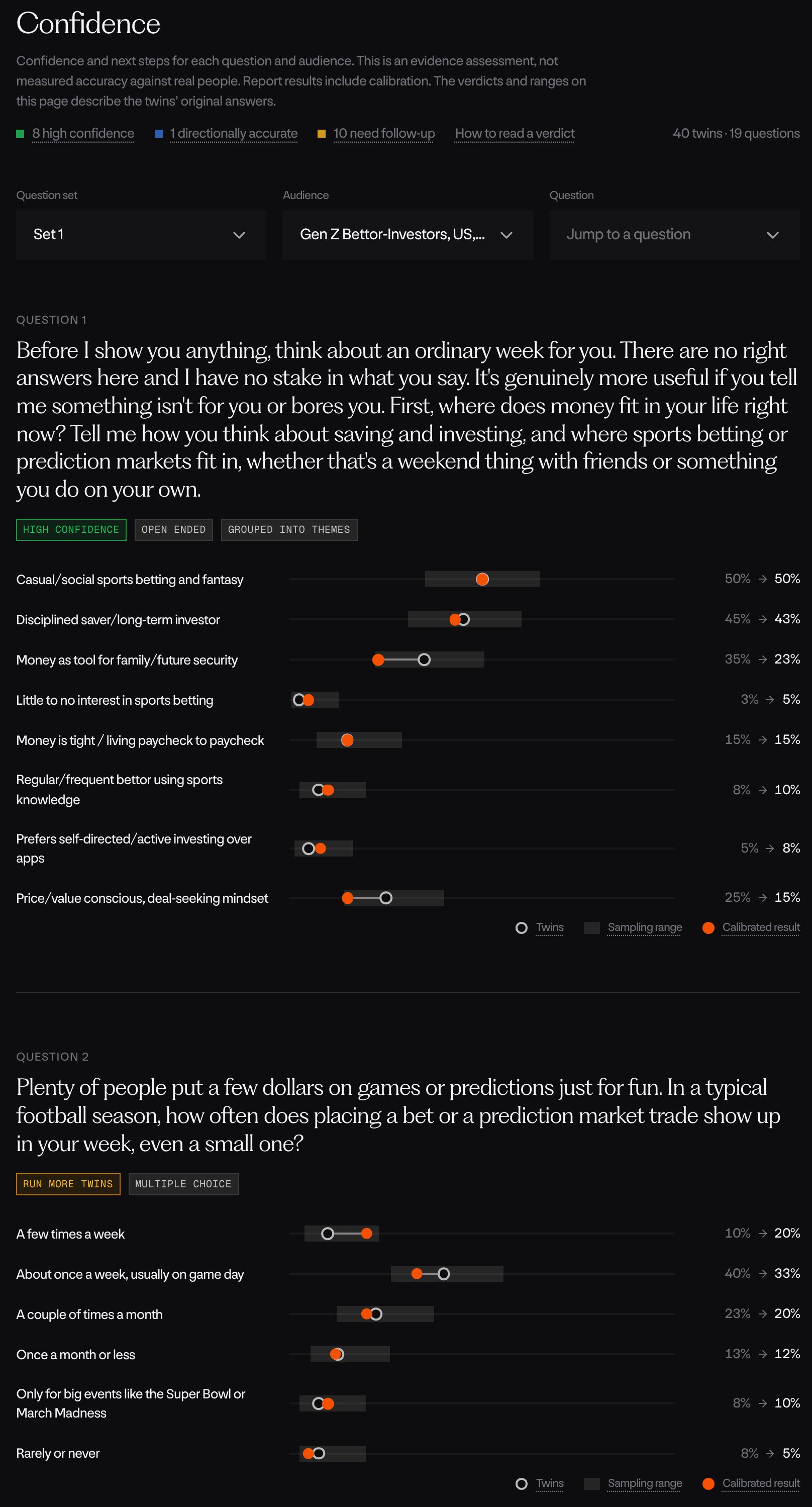
How a verdict is reached
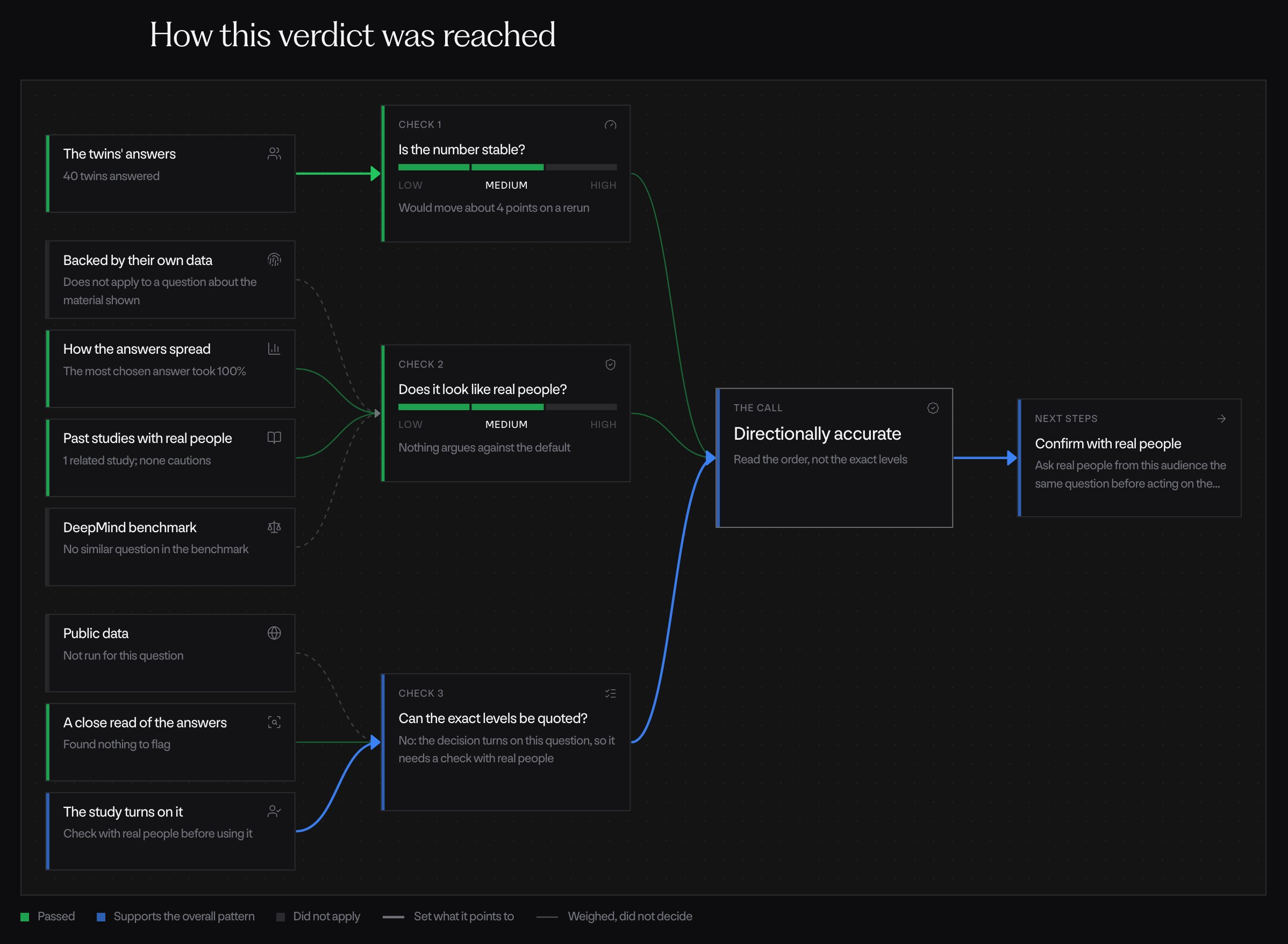
Every question goes through three checks in order. Click a question’s verdict on the Confidence tab to see how each check came out.Check 1: Is the number stable?
Would the answer shares move if you ran the Rehearsal again? Two things make a number move: how many twins answered, and how much each twin varies when asked the same thing twice. We combine both into the expected wobble, the number of points the shares would likely shift on a rerun.
- High: about 8 points of wobble or less.
- Medium: 10 points or less.
- Low: more than 10 points.
Check 2: Does it look like real people?
Could twins be off on this kind of question for this audience? This check starts at Medium and moves only when the evidence points one way. Exactly one rule decides it:
- Raised to High: a past study or head-to-head benchmark with real people backs twins on this kind of question, and nothing specific argues the other way.
- Lowered to Low: a past study shows twins miss on this kind of question, or one of these applies:
- The question hits a known weak spot for twins: price levels, the physical senses, or an audience we haven’t validated.
- The twins agreed far more than a real panel does, and public data doesn’t explain it.
- The twins disagree with strong public evidence, and their reasons repeat a template.
- Too few twins could back their answer from their own history.
- Kept at Medium: the public record matches the twins’ level even though their own backing is thin, or no evidence points either way.
Check 3: Can the exact levels be quoted?
When the first two checks hold, this one decides between High confidence and Directionally accurate. The result is directionally accurate when any of these is true:
- Published figures disagree with the twins on the levels or the top answers.
- The question asks for a price level. Twins can show which way price moves people better than the exact amount they’d pay.
- A close read of the answers lowered trust in the levels, for example when every twin chose on price alone.
- A clear favourite leads a pick list. In past studies twins overstated a clear leader’s margin by about 20 points, so the leader can be read and the size of its lead can’t.
- The decision turns on this question, so it needs a check with real people.
The evidence behind each check
Confidence draws on four kinds of evidence. Each verdict shows which one decided it.The twins' own data
Each answer is checked against what’s known about that twin’s real person: interviews, surveys, profile and posts. An answer is strongly backed, partly backed, or has no basis. This matters for questions about a person’s own life and habits. It doesn’t apply to questions about material the twins were shown, because the answer lives in the material.
Past studies with real people
Our library of studies where real people answered questions like yours. When one covers your kind of question, it carries the most weight, and the verdict links to it.
Public data
An independent estimate of how an audience like yours would answer, built from published sources without seeing the twins’ answers. It’s compared with the twins on both the levels and the order of answers.
A close read of the answers
A sample of interviews is read for how the twins reached their answers. It catches problems the numbers hide, like twins choosing the image that matches their own day instead of the one that sells the product.
When a question needs follow-up
A question that needs follow-up is tagged with the next step.Run more twins
The number isn’t stable yet. Open the question for the recommended number of distinct twins, then run again. Asking the same twins again doesn’t help; it needs new people.
Confirm with people
Ask real people from this audience the same question before you rely on it. The question says what to check, such as the size of a margin.
Review evidence
Confidence is low without one specific fix. Open the question and read the evidence.
Calibration
Calibration adjusts the answer shares in your report so they sit closer to what real people would say. It applies to multiple choice, rating scale and select-all questions, and to open answers once they’re grouped into themes. Ranking questions show plain counts.Why twins need it
Twins are more decisive than people. A real panel spreads its answers more than a group of twins does, and twins pile onto a favourite harder than people do. Left alone, twin answer shares exaggerate the leader and squeeze the rest.How it works
1
Use each twin's full leaning
When a twin answers, we record how likely it was to pick each option, along with its final pick. Because twins are more certain than people, we soften each twin’s leaning, then average across the audience.
2
Forecast the audience independently
A separate forecasting model predicts how an audience like yours would answer the same question. It sees the question, the options and the audience definition. It never sees the twins’ answers.
3
Blend the two
The calibrated result is an even blend of the twins and the independent forecast. We chose this blend because it came closest to real people on our test set of questions where real panels answered.
Where you see it
- The report, its charts and the cross tabs all show calibrated numbers.
- On the Confidence tab, the orange dot is the calibrated result, the same figure as the cross tabs’ Total column.
- The gray range and the verdict describe the twins’ original answers, before calibration. The range is the approximate 95% sampling range of those answers.
What Confidence doesn’t tell you
- Whether twins are wrong. A verdict says how much to trust an answer, not that the answer is incorrect.
- Whether the question was well written. A leading question can earn a stable, confident verdict.
- Whether the audience is right. Confidence treats the audience as you defined it. Building it to match that definition is the audience builder’s job.
Next: audience size and twin fidelity
How many twins you need for a stable answer.